The FBI just warned that hackers are using an AI-powered tool to break into organizations faster than ever. Here’s what organizations across New Hampshire and Maine need to know.
For years, a cyberattack took time. A hacker had to find a weak spot, test it, work their way in, and figure out where the valuable data lived. That could take days or weeks, which gave organizations and their IT teams a window to notice something was wrong.
That window is getting smaller.
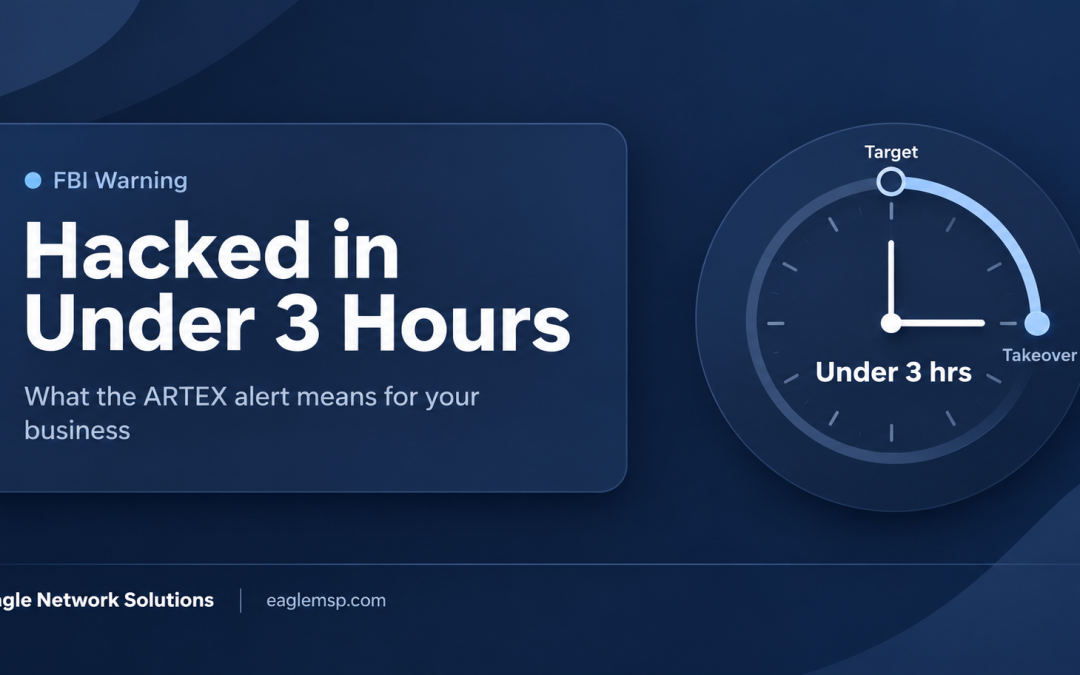
On November 13, 2026, the FBI issued a FLASH advisory warning that cybercriminals and state-aligned hackers are using an AI-powered tool called ARTEX to automate attacks against organizations worldwide. In some cases, attackers went from picking a target to gaining administrator-level access in under three hours.
FBI FLASH Advisory: November 13, 2026 (FLASH-20261113-001). The FBI reports that multiple threat groups have used ARTEX since at least August 2026 against organizations in finance, government, technology, defense, healthcare, and other sectors. The advisory is public and cleared for sharing. Read the full FBI advisory.
What is ARTEX?
ARTEX started out as a legitimate security tool. It was built for penetration testing, which is when security professionals try to break into a company’s systems, with permission, to find weak spots before criminals do.
The problem is that ARTEX does most of that work on its own. Someone gives it a target and a goal, and a team of AI “agents” splits up the job. One plans the attack, while others scan for weaknesses, try ways in, and share what they find. It plugs into popular AI models to do this and needs very little human input once it gets started.
Its creator took the original version offline in October 2026 after seeing it misused, but copies are still circulating. In the wrong hands, it works like a burglar who can check every door and window on the street at the same time.
Why This Matters to Your Organization
- Speed: When an attacker can reach your most sensitive systems in under three hours, there is very little time to spot the problem and respond.
- Small gaps become big breaches: ARTEX is good at connecting small weaknesses. A forgotten employee portal or a single exposed password can become a path to sensitive records, other accounts, or even the companies you work with.
- No organization is “too small”: Many small organizations assume they aren’t worth an attacker’s time. Automation changes that math. When a tool does most of the work, attackers don’t have to pick and choose. They can go after many organizations at once.
The Bigger Lesson: Every Microsoft 365 Add-On is a Door
In October 2026, Microsoft reported that a China state-aligned group it tracks as Storm-0940 used ARTEX after compromising one specific product: a ConnectWise Cloud Backup application. Using that app’s stolen credentials, the attackers attempted to sign in to more than 2,250 Microsoft 365 customer environments connected to it.
Two things are worth knowing. This involved one backup product, not ConnectWise’s tools as a whole. And 2,250 is the number of environments targeted, not the number broken into.
The real lesson applies to every organization that uses Microsoft 365.
Over time, many organizations add extra apps to Microsoft 365, like backup tools, scheduling apps, e-signature services, and email add-ons. Each one is given access to your mailboxes and your organization’s Microsoft 365 account (often called your “tenant”). That access is useful, but it also means every add-on is a door into your organization. The fewer unnecessary doors you have, and the tighter each one is locked, the safer you are.
Warning Signs to Watch For
- The FBI and Microsoft point to signs like these that an automated attack may be underway:
Sudden bursts of login attempts or activity, far faster than any person could manage - People or apps accessing data they don’t normally touch
- Unexpected password changes, new administrator accounts, or new permissions
- Apps connected to your Microsoft 365 that no one remembers approving
What Organizations Should Do Right Now
ARTEX makes attackers faster, but it doesn’t make the basics obsolete. It makes skipping them more dangerous. Here’s where to start:
- Keep everything updated. Prioritize anything that can be reached from the internet, like remote access tools, email, websites, and customer or vendor portals.
- Close the doors you forgot about. Remove old portals, unused apps, and accounts belonging to former employees or past vendors.
- Turn on multi-factor authentication (MFA) everywhere. That extra sign-in step stops many password attacks in their tracks, especially on administrator accounts.
- Give people and apps only the access they need. If an app only needs to read your calendar, it shouldn’t be able to read every inbox.
- Review what’s connected to Microsoft 365. Know which outside apps and vendors have access, and remove anything you don’t recognize or no longer use.
- Have a plan to act fast. Know who to call, how to shut off access, and how to isolate an affected computer. In a three-hour attack, minutes matter.
- Report suspected attacks. The FBI asks organizations to report possible compromises at ic3.gov.
What Every Employee Should Do Right Now
Technology controls matter, but attackers still need someone to slip up. These habits make the biggest difference this week:
- Stay calm. Scammers and attackers count on panic. Messages that feel urgent, scary, or rushed are designed to make you act before you think. Slow down, and if something feels off, ask before you click.
- Never share your password or sign-in codes. Not by email, phone, text, or on a page you reached through a link. A real IT team should never need your password. If someone asks for it, stop and call your IT provider on a number you already have.
- Be extra careful with sign-in requests. Watch for emails asking you to log in, sign-in pages that look slightly off, login alerts you didn’t trigger, or approval prompts on your phone you weren’t expecting. Don’t approve or enter anything. Report it.
- Now is not the time for BYOD. BYOD means “bring your own device,” like using a personal laptop or home computer for work. If that device isn’t covered by your organization’s security tools, no one is keeping it updated, watching it for trouble, or able to lock it down if something goes wrong. ARTEX looks for exactly that kind of weak spot. Stick to company devices your IT provider protects.
Questions to Ask Your IT Provider This Week
Not sure where you stand? These questions are a good place to start:
- If one of our accounts started acting strangely in the middle of the night, who would notice, and how fast would they respond?
- Which outside vendors and apps can access our Microsoft 365?
- Is MFA turned on for every account, including administrator accounts?
- When were our internet-facing systems last updated?
- Are any personal devices being used for work that aren’t protected by our security tools?
- What is our plan if an account is compromised?
If those questions are hard to answer, that’s useful information too. It tells you where to focus first.
A Word from Our CEO
When I opened the doors at Eagle Network Solutions, ransomware didn’t exist. However, the basic security building blocks have always been there. Over our last 22 years, some of our clients occasionally have insisted on removing obstacles that make them less secure, but provide more efficiency to their experience. To be clear, more security is good, but it comes at the cost of less functionality. There is no way around this. The fulcrum of that balance beam should not be in the middle. It should give extra weight on security. Small businesses are not too small to be targeted – it just hurts them more when it happens. Having an MSP like Eagle vastly increases your chances of knowing when bad things start knocking on your technology door whereas a one-person IT shop or in-house IT resource likely does not have such tools to alert them. We invest a lot of money and resources in such tools that work while you sleep. There are no guarantees in this current threat landscape, but at Eagle, we put a lot of effort into keeping you safe and we react with a first responder mindset if there is even a possibility of a compromise. In this current state of hacking and holiday weekends coming up where bad actors work while we relax, now more than ever, it is crucial to secure your businesses and your IT infrastructure.
The Eagle never sleeps, so you can. Kaleb Jacob, CEO and Founer, Eagle Network Solutions
Straight Talk from Eagle
AI isn’t going away, and it cuts both ways. The same technology that helps organizations work smarter is now helping attackers work faster. That isn’t a reason to panic. It’s a reason to make sure the basics are done well and that someone is watching.
Here’s the good news: ARTEX doesn’t rely on magic. It moves fast by chaining together familiar weaknesses, like an outdated system, a reused password, or an app with more access than it needs. Close those gaps, and you take away the shortcuts it depends on.
At Eagle, security is a mindset, not a service. We approach every alert with a first responder mindset: stay calm, act fast, and protect the people who count on you. We help organizations across New Hampshire and Maine keep their systems updated, their accounts locked down, and their vendor connections in check, so you can focus on the work that matters most.
The Eagle Never Sleeps… so you can.
How would your organization hold up against a three-hour attack?
Let’s find out together. Eagle Network Solutions provides managed IT and cybersecurity for organizations across New Hampshire and Maine, with real people you can call and meet.
📍 Bedford, NH: 603-782-0700 | Scarborough, ME: 207-613-1144
Talk to Eagle: eaglemsp.com/contact/